Furufjellet
Out Stealing HorsesFurufjellet is a forested ridge above the river valley, reached by Trond Sander and his father on horseback as summer is nearing its end. The ride carries them from familiar paths into steep, wooded terrain and finally to a high point from which the river and meadows spread below. The mountain matters not only as a landscape to be crossed: from its summit, the familiar valley becomes something Trond knows he is about to leave, while the route east points toward Sweden and a future his father has not explained.
Setting and approach
Furufjellet belongs to a rural border district only a few kilometres from Sweden. The landscape around it is shaped by forest, river, fields, and small farms. Barkald’s property includes a large stretch of forest, where four horses are kept behind barbed wire strung between trees. That detail links the mountain’s riding country to working land and local ownership, rather than to a wilderness beyond human use. The valley’s meadows are cut for hay, and paths connect the river cabins, barns, and farms with the wooded slopes.
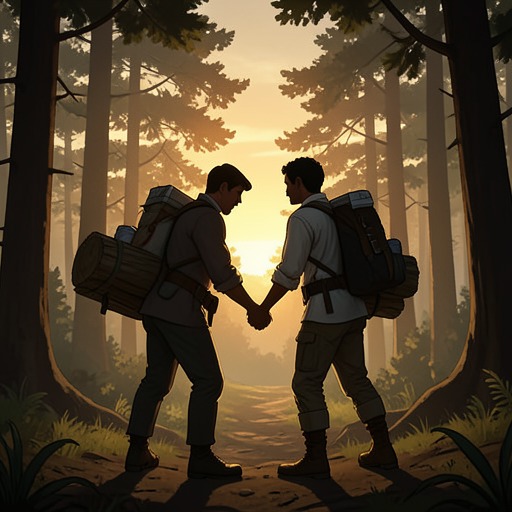
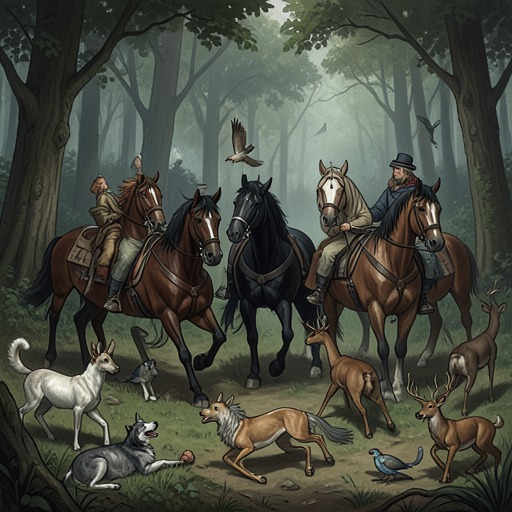
The approach to Furufjellet begins on a track from the cabin, past an old wooden barn where Trond had recently spent a night. Trond rides behind his father, still learning how to sit securely: his father tells him to loosen his hips and move with the horse. The instruction makes the journey a practical lesson as well as an excursion. The horses have been groomed, their manes shining; saddle-bags and rolled rugs are packed, and anoraks are tied with the bedding for sleeping outdoors. The preparations suggest that the ride will take them well beyond an ordinary passage through the nearby fields.
They leave the better-known route and follow a path that turns east, narrowing into a zigzagging moose track through tall birches. The trees’ crowns sweep above them, and the track crosses a deep stream cold enough to soak Trond’s trousers as the horses trot through it. Beyond the birches, dense spruce covers the steep mountainside, described as untouched by loggers. The changing terrain marks the transition from settled valley to mountain slope without separating the two: the route remains a continuous passage through a lived-in, worked landscape.
The ridge and the view
The horses climb to the top of the ridge, where Trond and his father pause and turn to look back. From there, the river winds dull silver through the treetops and between newly mown meadows; cloud banks lie above the ridge on the opposite side of the valley. The view is broad enough to place the river, fields, and wooded heights into a single prospect. Trond judges it grander than the fjord near home, a comparison that makes clear how completely this valley has captured his attention.
Yet the view does not produce the sadness Trond expects might accompany a last look. He knows it will be a long time before he can see the valley this way again, but feels irritated and almost angry instead. He wants to continue. His father, facing west, seems to him to have stayed at the summit longer than necessary. Trond turns his horse away from the valley and presses for them to move on. The moment gives the ridge a double character: it offers a place to look back, but Trond resists remaining there to contemplate what he is leaving.
A route toward the border
When they set off again, Trond’s father turns east, in the direction Trond knows Sweden lies. The boy has assumed that this is where they are going, although his father has said nothing about their destination. Trond imagines that the landscape beyond the border will look much the same as the landscape on this side, yet feel different because he has never been there. Furufjellet thus becomes a threshold in Trond’s understanding: it does not itself explain the journey, but its eastward orientation gives shape to his expectation of what comes next.
The descent leads through a narrow pass, with the view blocked on every side. The horses pick their way cautiously over pebbles and loose stones on the steep slope; iron-shod hooves ring between the rocks and echo through the pass. Trond recognizes that they are no longer moving quietly, but believes it does not matter. There is no German patrol pursuing them now, no border police with tracking dogs, and no distant pursuer keeping their nerves under pressure. His thought sets the present ride against the danger associated with wartime movement across this border country.
That contrast has a wider historical resonance. Elsewhere in the valley, a German guard had watched the bridge approach, and Franz eventually detonated the device that shattered the wooden bridge. In a later flight, the fugitives reached the river and were confronted by soldiers at its bank. These events are not presented as occurring on Furufjellet; they establish the danger and surveillance that had given routes through the surrounding countryside a different meaning. Against that history, the horses’ noisy descent toward Sweden belongs to a more private passage, though the border still carries the possibility of escape and change.
Narrative significance
Furufjellet brings together the physical and emotional directions of Trond’s ride. Its summit opens the valley behind him, while the mountain path continues east toward a place he has never seen. The mountain’s scenery is concrete—cold water splashing over the horses, birch and spruce, loose stones, silver river—but its narrative force comes from the way those details organize departure. Trond does not linger over a farewell; he turns his horse and urges his father onward.
The outing also gives the father-son relationship a form built from shared action rather than explanation. Trond’s father offers riding advice, leads the horses through unfamiliar terrain, and chooses the direction of travel without stating where they are headed. Trond follows while making his own guesses. Furufjellet is therefore both a place within the valley and a vantage from which the boy begins to imagine beyond it: a remembered landscape of summer, labor, and family intimacy poised at the edge of an unknown destination.